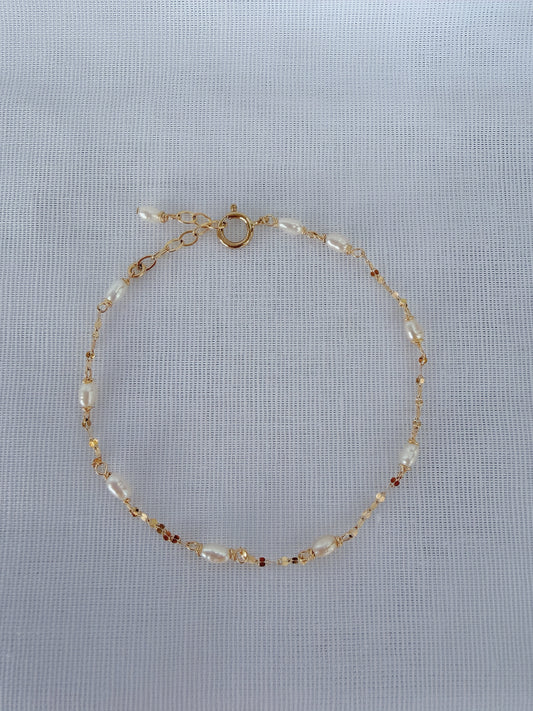
Un guide des types de perles : perles Keshi, baroques, d'eau douce et de riz
Partager
Toutes les perles ne sont pas égales – et c'est ce qui les rend belles
Entrez dans n'importe quelle boutique de joaillerie fine et vous rencontrerez une variété éblouissante de perles – certaines parfaitement rondes, d'autres délicieusement irrégulières, certaines avec un éclat doux, d'autres avec un lustre semblable à un miroir. Comprendre les différences entre les types de perles vous aide à apprécier ce que vous portez et à faire des choix plus intentionnels lors de la constitution de votre collection.
Chez Mistissi, nous travaillons avec certaines des plus belles variétés de perles disponibles, chacune avec son propre caractère et son propre charme. Voici votre guide des types de perles que vous rencontrerez le plus souvent.
Perles d'eau douce
Les perles d'eau douce sont cultivées dans les lacs, les rivières et les étangs – principalement en Chine – et sont le type de perle le plus largement disponible au monde. Ne vous laissez pas tromper par leur accessibilité : les perles d'eau douce peuvent être extraordinairement belles, avec un lustre doux et satiné et une large gamme de couleurs naturelles, y compris le blanc, la crème, le rose et le lavande.
Contrairement aux perles d'eau salée, les perles d'eau douce sont composées presque entièrement de nacre (la substance irisée qui donne aux perles leur éclat), ce qui les rend exceptionnellement durables. Elles se présentent sous une variété de formes – rondes, quasi-rondes, ovales, boutons et baroques – et de tailles allant des minuscules perles de semence aux spécimens impressionnants de plus de 12 mm.
Idéal pour : Le port quotidien, les superpositions et la constitution d'une garde-robe polyvalente de perles. Les perles d'eau douce offrent une valeur exceptionnelle sans compromettre la beauté.
Explorez notre collection de colliers de perles et nos bracelets de perles présentant des perles d'eau douce.
Perles baroques
Les perles baroques se définissent par leurs formes irrégulières et non sphériques – et elles figurent parmi les perles les plus captivantes au monde. Aucune perle baroque n'est identique, ce qui signifie que chaque bijou en perle baroque est véritablement unique. Leurs formes organiques et sculpturales peuvent ressembler à des larmes, des ailes, des pièces de monnaie ou des formes abstraites qui semblent presque d'un autre monde.
Loin d'être considérées comme imparfaites, les perles baroques sont célébrées par les designers et les collectionneurs pour leur qualité artistique. Leurs surfaces irrégulières captent la lumière de manière inattendue, créant un lustre dynamique et vivant que les perles parfaitement rondes ne peuvent tout simplement pas reproduire.
Les perles baroques peuvent être d'eau douce ou d'eau salée. Les perles baroques d'eau douce ont tendance à avoir un lustre riche et profond, tandis que les perles baroques d'eau salée (telles que les perles baroques des mers du Sud ou de Tahiti) sont prisées pour leur taille et leurs couleurs exotiques.
Idéal pour : Les pièces maîtresses, les amateurs de bijoux artistiques et tous ceux qui apprécient la beauté de l'imperfection naturelle.
Découvrez nos boucles d'oreilles en perles baroques et nos colliers de perles baroques.
Perles Keshi
Les perles Keshi sont un sous-produit fascinant du processus de culture des perles. Lorsqu'un mollusque rejette le nucléus implanté lors de la culture, il continue parfois à produire de la nacre autour du tissu restant – créant une petite perle entièrement en nacre, sans aucun nucléus. Le résultat est une perle d'un lustre exceptionnel.
Le mot « keshi » vient du mot japonais signifiant « graine de pavot », reflétant la petite taille des perles keshi originales. Aujourd'hui, les perles keshi peuvent aller de minuscules formes ressemblant à des graines à des pièces plus grandes et plus substantielles. Leurs formes sont presque toujours irrégulières – plates, courbées, en forme de pétale ou allongées – ce qui leur confère une qualité organique et sculpturale.
Parce que les perles keshi sont entièrement composées de nacre, elles ont un lustre intense, semblable à un miroir, qui rivalise avec les plus belles perles de culture. Cet éclat extraordinaire, combiné à leurs formes uniques, fait des perles keshi un favori parmi les designers de bijoux recherchant quelque chose au-delà du conventionnel.
Idéal pour : Les superpositions maximalistes, les pièces maîtresses artistiques et ceux qui veulent le plus haut lustre dans une forme non conventionnelle.
Perles de riz
Les perles de riz sont de petites perles d'eau douce allongées qui ressemblent à des grains de riz. Elles font partie des variétés de perles les plus délicates et les plus fines, ce qui les rend idéales pour les créations de bijoux fins et minimalistes. Leur petite taille et leur éclat subtil leur confèrent une élégance discrète qui s'intègre parfaitement aux pièces de tous les jours.
Les perles de riz sont souvent utilisées dans les colliers à plusieurs rangs, les bracelets délicats et les boucles d'oreilles pendantes où leur petite taille crée une sensation de légèreté et de féminité. Malgré leur taille modeste, les perles de riz de qualité ont un joli lustre et une surface lisse et uniforme.
Idéal pour : L'esthétique minimaliste, la superposition avec d'autres types de perles, et ceux qui préfèrent les bijoux discrets et raffinés.
Comment choisir le type de perle qui vous convient
La « meilleure » perle est toujours celle qui correspond à votre style personnel et aux occasions pour lesquelles vous vous habillez. Voici un guide simple :
- Pour une polyvalence intemporelle : Choisissez des perles d'eau douce en blanc ou crème classique – elles vont avec tout.
- Pour des pièces artistiques et uniques : Les perles baroques et keshi offrent une individualité inégalée.
- Pour une élégance délicate et quotidienne : Les perles de riz et les petites perles d'eau douce sont des compagnons parfaits.
- Pour un lustre et un impact maximum : Les perles keshi offrent un éclat extraordinaire semblable à un miroir.
Chez Mistissi, chaque pièce est soigneusement conçue pour laisser la beauté naturelle de la perle occuper le devant de la scène. Parcourez nos Favoris Mistissi ou explorez nos meilleures ventes pour trouver votre perle parfaite.